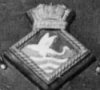
David Mercer MacDougall, Ministry of Information (MoI) Hong Kong
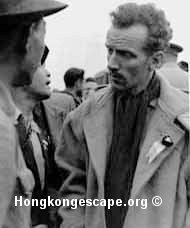
D M MacDougall 1904 - 1991
David MacDougall was on his second tour of duty in the Colony. He was posted back to the Colony as the Director of the Ministry of information when hostilities in Europe began.In Shaoguan (Kukong) the local mission doctor operated on Mac unsuccessfully, and he was then flown, along with other members of the escape party to Chungking for debriefing. The arrival of Cmdr Hugh Montague RN (Rtrd), Police Supt Bill Robinson of the Indian Police Intelligence unit, Captain Peter Macmillan, Captain Reginald (Freddie) Guest, Sq-Ldr Max Oxford, all staff officers of HKBHQ, David MacDougall, and Edwin (Ted) Ross both of the Ministry of Information in the early hours made the British national and regional press the same day 15th January 1942.
It was widely believed among his fellow escapees that Mac was an inteligence officer, Mac denied that he had any connections with the inteligence services.
Mac also declined an offer of $2000 by the US press for an exclusive account of the escape.
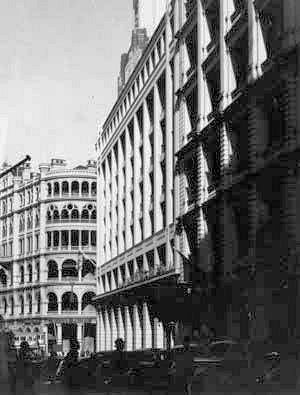
Left: The Gloucester Building where MacDougall moved his office to during the Battle for Hong Kong
Photo from the Collingwood family collection ©
David MacDougall MoI : "In Chungking there was a great deal that I was in duty bound to do – address meetings, give interviews to the press, and write articles. One of the latter is I think being syndicated in U.S.A. by the N.A.N.A. I could have cashed in to the tune of $2000 or more if I’d accepted some of the American offers for my story. Cables kept coming in. I refused them all out of hand; somehow I couldn’t think of cashing in on the situation with all my friends shut up in that terrible predicament." [26]
He also declined a lucrative salary package to stay in Chungking and Calcutta.
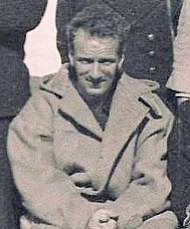
David MacDougall MoI : "The Ambassador is being transferred to Moscow as you will have seen but he is very anxious for me to stay on in Chungking on my own terms. My own ideas are to get transferred temporarily to London and then re-assigned in due course to one of the W. Indian colonies where we could be together. I could get a very large salary here – but I feel I want a change." [26]
Mac flew out from Chungking on Sunday 25th January to the Canadian run "West China Union University Hospital" at Chengtu in Szechwan Province. After locating the bullet by Xrays they operated the following day.
David MacDougall MoI : "I arrived a week ago, just as soon as I could get away from Chungking where I had so many friends, functions and blah-blah to compete with. Unluckily the plane was delayed 3 days and I had an extra dose of everything;
As soon as I arrived here I got a decent X-ray on me (various doctors on the way to Chungking had probed unsuccessfully for the bullet) and they found the bullet under the left shoulder blade, jinking about among my ribs. It had smashed through the shoulder blade and was fairly deeply embedded. They operated last Monday (26th Jan) but failed after two and a half hours to get the bullet. But there was no infection and no puss and in the end they decided to leave it in, and sewed me up again. They say it won’t do any harm.
They are absolutely first class people – very highly paid Canadians. I had a hellish four days after the operation, and had to have a lot of morphia, but I’m all right now; am getting up part of the day and eating like a horse.
The doctor’s wife had me carried to her house and installed there, where I am writing this. I can’t tell you the kindness I have had here – it’s overwhelming and un repayable." [26]
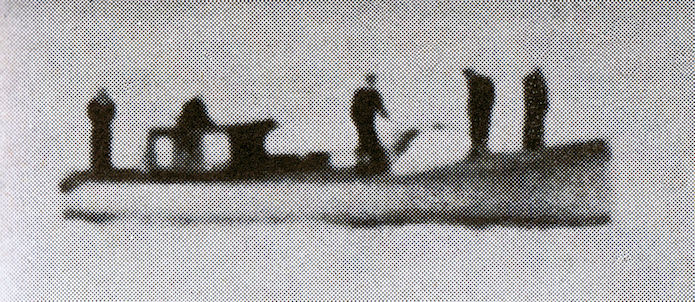
After convalescing at the Surgeons house Mac flew back to Chungking for a short period before leaving on the 20th February when Mac embarked on a ten day journey by air via Calcutta to Lagos, Nigeria, where he stayed with the Chief Colonial Secretary Alexander Grantham for several weeks before travelling on to London where he arrived in mid March.
Left: HMS Cornflower launch
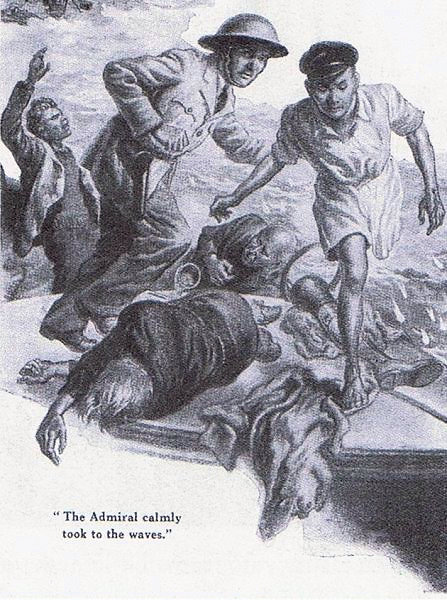
Adm Chan Chak: "The Danish steer man was the first one shot, then the engineer. MacDougall and others were wounded. Most of the stray bullets had hit the boat and even some had hit my helmet.
Hsu was very wary about me the “One Foot Admiral of 50” swimming such a far distance.
I insisted to carry my own gun and passport. Yeung could not swim and he suggested that we should go back to Hong Kong. “Going back means surrender. I would rather die!” I said.
I took off my life preserver (which was the last one on board) and gave it to Yeung. As I raised my hand, a stray bullet went
right through my left hand.
Yeung didn’t say anything anymore, he just jumped into the sea, followed by MacDougall with his wounded back.
YeeSiu-Kee and 2 other British soldiers had to remain on the boat. Yee could not swim and the 2 soldiers were badly wounded.
We were all sitting ducks in the water and non-stop bullets were flying everywhere.
I finally swam ashore on the small island right next to Apliechau." [6]
Left: Photo from Maj Goring's daring-do article on the escape published in 1949. [17]
Along with S.K. were two severely wounded volunteer crew left in the boat, the tall forty seven year old Jutlander, Alec (Alexis) Damsgaard, late Master of the C.S. Store Nordiske, & Sub-Lt J. J. Forster HKRNVR from Northern Ireland. After drifting all night S.K. bribed a junk man to take the two wounded to a hospital.
S.K. Yee: "I put the two others on a junk, asking the fishermen to take them to a hospital on the mainland (Hong Kong).
I was kept some days at Pak Sha wan and subsequently I had to return to the church at Apliechau, which was under the Reverend Cheng. I took shelter at the church for some days before making my final escape to Free China." [62]
Of the sixteen who set out on board the launch of "HMS Cornflower" (II), two were killed, one taken prisoner, another made good his own escape while the remaining twelve made it to the MTB's.
S.K, wearing Hsu Heng (Henry)'s shoes and clutching his bible, sought refuge with the Reverend Cheng in the Harbour Mission Church on Ap Lei Pai opposite Aberdeen. He eventually made his way to Kukong in free China where Chan Chak was still recovering. SK arrived on 5th February 1942 still wearing Hsu Heng (Henry)'s shoes, only to leave two days later as mysteriously as he had arrived after falling out with Chan over the allegedly missing $40.000 (£2,500 GBP) They remained bitter opponents for the rest of Chan's life.
Waichow
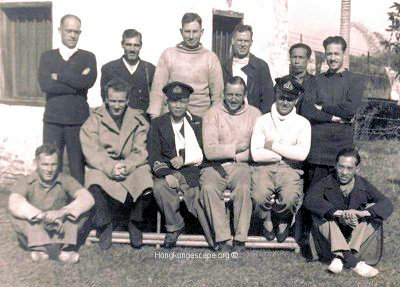
Back row: Supt. Bill Robinson, W. O. William M Wright HKRNVR, Capt. Peter Macmillan R. A., Capt. Reginald Guest 1st Mdsx, Coxswain Yeung Chuen ROC, Ted Ross MoI>
2nd row: David MacDougall MoI, Adm Chan Chak ROC, Major Arthur Goring Probyns Horse, Sq-Ldr. Max Oxford RAF
1st row: Cadet Holger Christensen, Lt-Cmd Hsu Heng (Henry) ROC.
Photo from Chan Chak collection ©
The four who were wounded, killed, captured or escaped seperately
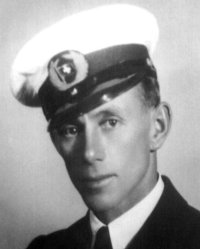
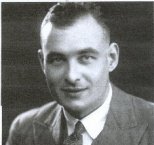
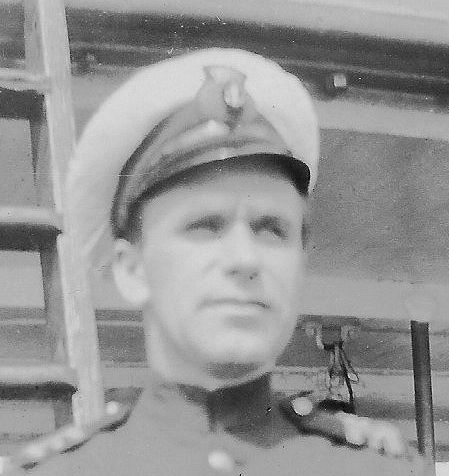
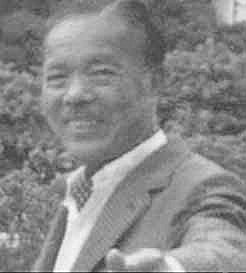
Alexis Damsgaard wounded POW. JJ Forster died of wounds. D Harley wounded/drowned. SK Yee escaped seperately
Admiral Chan Chak and David MacDougall revisited Aberdeen together on Sunday 26th May 1946 and reminisced over their incredible Christmas Day escape five years earlier.
6th January 1942 Kukong, Shaoguan
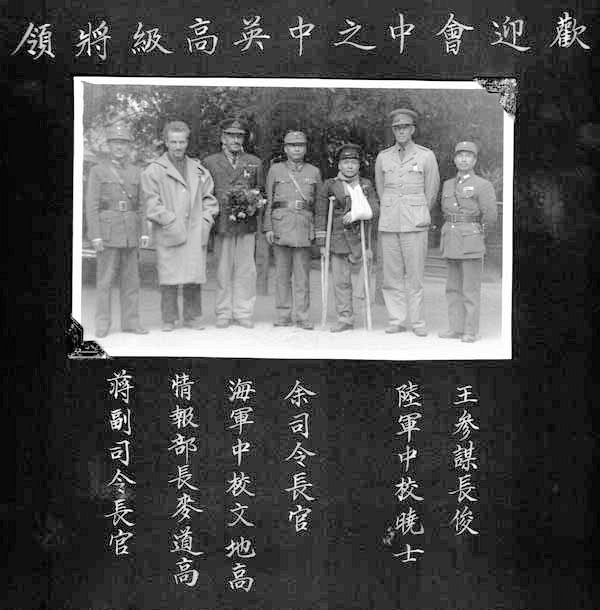
Left: British & Chinese senior officers in the Welcoming Ceremony
Photo fron the Chan Chak family collection ©
Deputy Commander General Jiang Guangnai, David MacDougall, Commander Hugh Montague RN, C-in-C General Yu Hanmou, Adm Chan Chak, Lt-Colonel Harry Owen-Hughes, and Chief of Staff General Wang Jun at at Binlu, Shaoguan (Kukong) 6th January 1942.
Translation by Chi Man KWONG. Research Assistant Professor, History Department, Hong Kong Baptist University.
Admiral Chan Chak kept the bullet removed from his left wrist, and had it mounted on a gold chain to wear on his lapel as a permanent reminder of his incredible escape from Hong Kong. After the war Chan became the first post war Mayor of Canton.
David was educated at Perth Academy and St Andrews University where he graduated with an M. A. in 1930. He was the Perth Academy sports champion three times. In 1931 he sailed to Hong Kong as a Cadet with the Colonial Service, returning to London at the beginning of the European hostilities. He later went back to Hong Kong as Secretary to the Far Eastern Bureau of the Ministry of Information. [92]
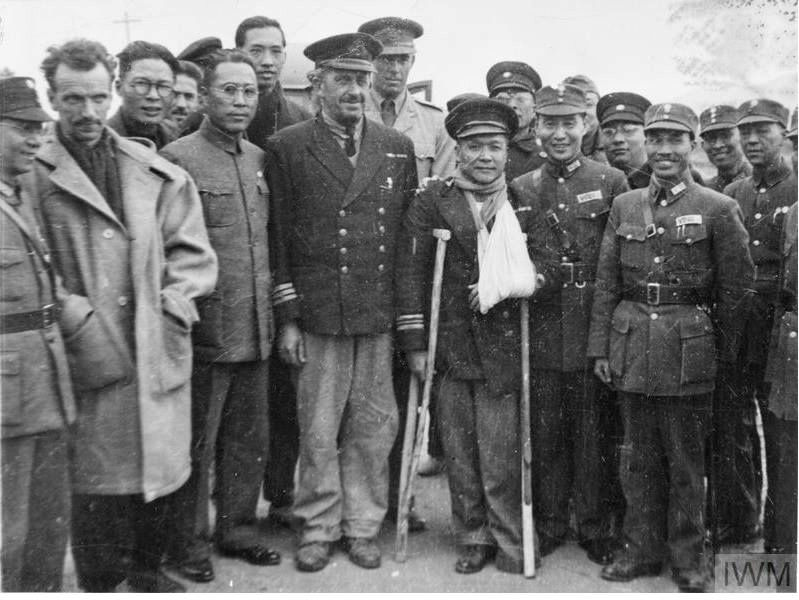
Left: Admiral Chan Chak with Commander Montague RN (Ret), Lt-Col Harry Owen-Hughes, David MacDougall, Ted Ross and Lt-Cmd Henry Hsu arriving in Kukong, Shaoguan, 6th January 1942
Photo IWM ©
The Ministry of Information (MoI) was a Government department to maintain public morale through the use of publicity and propaganda via the media. Home intelligence was a department within the MoI used to observe the public and monitor their mood, gathering intelligence from the likes of shop keepers, publicans, clergymen, shop stewards, as well as G.Ps, letter opening and phone tapping. The MoI also produced propaganda films for public showing. Adm Chan Chak and his liaison party were brought in to work with Mac in keeping the majority Chinese population onboard.
In 1944 Mac was appointed head of the Hong Kong Planning Unit within the authority of the Colonial Office. The unit was eventually incorporated into the armed forces as civil affairs staff, and MacDougall given the rank of Brigadier. Thus began a game of political chess with the Americans and Chinese for the restoration of British Sovereignty in post war Hong Kong as the prize.
He returned to Hong Kong on the 7th September 1945 as Brigadier Colonial Secretary in time to witnessed the official Japanese surrender to Adm Harcourt in Government House on the 16th September.
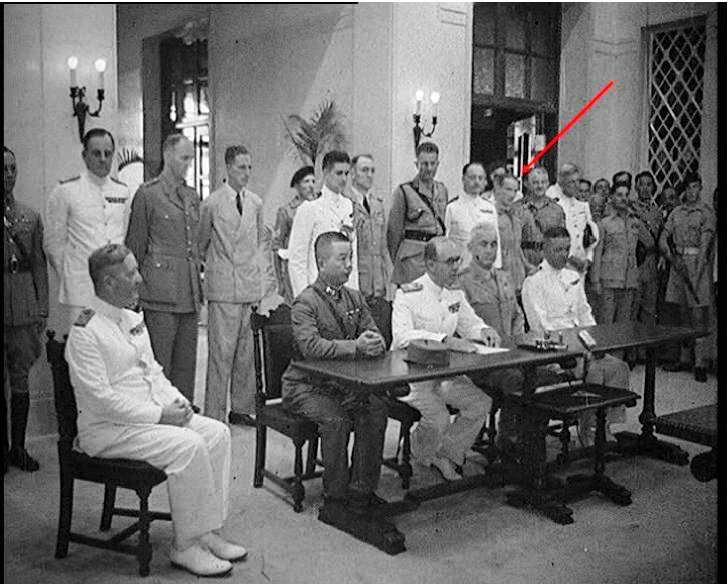
Left: Brigadiier Clonial Secretary David MacDougall, (arrowed) standing next to Lt.-Colonel Lindsay Ride, with Brigadiier Francis Wogan Festing (Frontline Frankie), C-in-C Hong Kong 1945-46 & again 1949, standing next but one, MacDougall returned as Brigadier Colonial Secretary 7th September 1945 and witnessed Maj.-Gen. Umekichi Okada and Vice Admiral Ruitaro Fujita sign the instrument of surrender in Government House 16th September 1945 to British officers led by Admiral Sir Bruce Fraser, 1st Baron Fraser of North Cape, sitting extreme left. At the table L-R are Major-General Pan Hwa Kuei ROC, Rear Adm Cecil Harcourt, Colonel Adrian Williams, US Army and Captain W B Creery Royal Canadian Navy..
Photo from the MacDougall family ©
Civil administration was restored when H.E. Sir Mark Young was sworn in on the 1st May 1946 and military administration under Vice Admiral Sir Cecil Harcourt disolved. Mac remained in his position as Colonial Secretary.
Mac remained in Hong Kong from 1945 - 1949, with a brief period as acting Governor after Mark Aitchison Young (楊慕琦) from 17th May through 25th Jul 1947 when Alexander William George Herder Grantham took office as the 22nd Governor of Hong Kong.
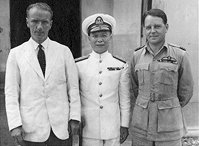
David MacDougall, Admiral Chan Chak C-in-C ROC (former Mayoy of Canton)
and Wing Commander Max Oxford in June 1946
Photo from the Oxford collection ©
Mac had very strong views on how Hong Kong should be run, and was not at all comfortable with Colonialism, refusing to acquire a sword or uniform. As well as achieving academically he excelled at sports winning awards for Golf, Rugby, and tennis. He was an ardent reader of the Polish author Joseph Conrad which inspired him to travel. He was a modest man and learnt Cantonese fluently and a little Mandarin which put him in good stead for his post-war office as Brigadier Colonial Secretary of Hong Kong.
Mac remained good friends with Admiral Chan Chak, the former President of the Southern Kuomintang Nationalists party (KMT) and now the first post war Mayor of Canton. Max Oxford returned to Hong Kong as Deputy Director of Kai Tak airport.
Admiral Harcourt was head of the military administration with MacDougall looking after the civil side. Mac was responsible to Harcourt ‘on matters which the Admty’ or War Office had an interest and to ‘the Secretary of State for the Colonies with regard to other matters.’
He quickly restored the administration in Hong Kong to a level of efficiency that made it the most shining example of all the territories liberated from the Japanese. David changed the administration from the pre-war British colonial ruling class system to a very much Chinese integrated administration which led to the eventual handing back of Hong Kong to China in 1997.
Members of the Christmas Day escape who returned to help rebuild the Colonony of Hong Kong after its return to British control in 1945 included
- David MacDougall Returned on 7th September 1945 as Brigadier Colonial Secretary with the Military Administration. Mac took early retirement in 1949 to take up farming in Suffolk, East Anglia, UK.
- Ted Ross Returned briefly with the British Military Mission before going on to Japan in 1946 where he worked closely with Douglas MacArther's administration. Ted returned to Hong Kong in 1951 following a year long round the world honeymoon with his bride, staying untill 1965.
- S K Yee Returned with the British Military Mission before going into banking then forming the S.K. Yee Medical Foundation
- Lt-Cmd Henry Hsu ROC Returned after retiring as Vice Admiral ROC, in business then became an international hotelier based in Hong Kong
- Colonel Harry Owen-Hughes Returned to work in D M MacDougall's administration & as Commandant of the post war HKVDC
- Lt Arthur Pittendrigh Returned to HK in 1945 to command the Maritime Police Service with the rank of Colonel.
- Lt Tommy Parsons Returned to Jardine Matheson's
- Sub-Lt Arthur Gee Returned as night editor of The China Mail
- Sq-Ldr Max Oxford RAF Returned in mid October 1945 as Deputy Director of Kai Tak International Airport
- F W (Mike) Kendall Returned working for the Philippines Airline and was based in both HK and Manila
- Monia (John) Talan Returned to run a travel business before going into laundry.
- Colin McEwan Returned as Director of physical education
- Guerrilla leader Leung Wingyuen was appointed as Colonel Advisor in the Chan Chak administration in Canton. [6]
- Admiral Chan Chak was appointed to be the first post-war Mayor of neighbouring Canton on 1st April1945. The following year he resigned to become the first post war C-in-C South China Navy. [6] [85]
The SOE escape team
Mike Kendall
Colin McEwan
[John] Monia Talan
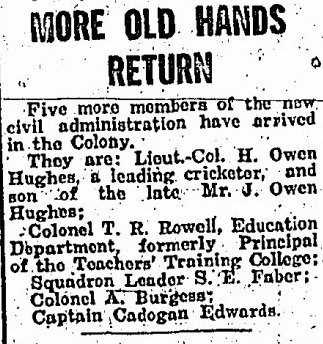
Lt-Colonel Harry Owen Hughes returned to Hong Kong on the 12th September 1945 as part of David MacDougall's civil admin team. Harry also Commanded the post war Hong Kong Volunteer Defense Corps.
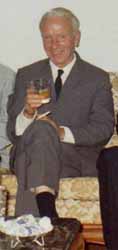
Photo from the MacDougall family collection ©
David MacDougall with the Chan & Hsu families in Hong Kong 1969
"David retired from the Colonial Service and farmed in Suffolk until the late 1960s. Latterly he divided his time between East Anglia and Scotland, and passed away in Strathtay, very close to his home town of Perth, in May 1991 at the age of 86.”
Research and web publication by Buddy Hide Jnr ©
The contents of this web site led to a considerable number of escapee families contacting me and now each other, and remains the principle source of contact and private information for the spin off projects that have followed. The personal accounts enabled me to record the complete and true account of this remarkable episode of Sino-British war time co-operation. The information compiled here has directly resulted in a museum exhibition in Hong Kong, a re-enactment of the escape in Hong Kong and China, with a movie drama and documentary in the making.
Contact | Mwadui | Guest Book | Top | © MCMXCVI Hamstat Integrated Systems | Escape from Hong Kong
Site maintained by Hamstat Integrated Systems Inc
© Hong Kong Escape.org 2019